
News
Gabbi raises US$4.4m to advance breast cancer early detection
Gabbi will launch in 2023, giving women access to risk assessment results and personalised care plans

The US risk assessment and care navigation company Gabbi has raised US$4.4m to support breast cancer early detection.
Gabbi will provide a solution that will include risk assessment results, personalised ongoing care plans and a care concierge and deliver results for women of all ages and ethnicities to enable proactive action.
It will launch at the beginning of 2023 via employers who will be able to provide Gabbi as a benefit to their employees.
The round led by Bread and Butter Ventures saw participation from Female Founders Fund, WR Hambrecht, Phoenix Rising, Claridge Ventures Advisors VC, Coyote Ventures, Gaingels as well as angels including David Kidder, Sarah Jones Simmer and Naseem Sayani.
The financing will go towards funding team growth and product development to empower women to take control of their health.
“Just as streaming platforms have paired user specific behaviours, hyper personalisation and a vast library of media content to deliver a 100 per cent unique user by user experience, Gabbi is, for the first time in the healthcare space, pairing individual women’s input with vast amounts of clinical data and tested medical standards to deliver more accurate risk profiles for women of all ages and races in the comfort and intimacy of their own home,” said Kaitlin Christine, founder and CEO of Gabbi.
“I know firsthand the difference of a timely diagnosis – when caught early, the five-year survival rate is 99 per cent.
“Everyone should have the tools that allow them to understand their risk and get access to the appropriate care.”
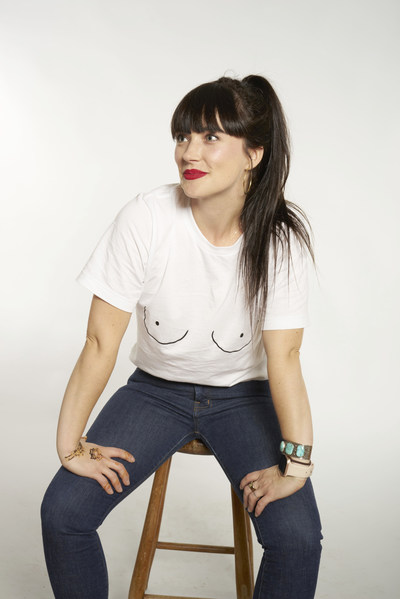
Kaitlin Christine, founder of Gabbi
Christine lost her mother to breast cancer ten years ago after a delayed diagnosis.
She was then diagnosed with cancer herself during a preventative mastectomy when she was 24 years old.
Since then, the founder has dedicated her career to trying to change the paradigm around delayed diagnosis.
The five year survival rate for a late diagnosis is 31 per cent. Gabbi aims to change that by utilising data through GRAM – Gabbi Risk Assessment Model – a proprietary machine learning risk model that takes into account four different categories of data.
Mary Grove, general partner at Bread and Butter Ventures, said: “We are thrilled to back Kaitlin and the Gabbi team in their critical mission.
“Their unique approach of leveraging data to predict risk and ultimately empower women to have more ownership of their health outcomes is transformative.
“Gabbi’s laser focus on women age 21-49 who are historically not included in these screenings changes the access game for all.”
Christine recently shared that Grove and other investors supporting the company understand the issue and have a deep connection to the mission of advancing breast cancer diagnosis through a personal or family experience.

Entrepreneur
Women’s Health Week USA confirms full speaker lineup and records 170 pitch applications

By Women’s Health Week
With four weeks to go until Women’s Health Week USA, the excitement is ramping up!
The final early bird pricing closes this Friday, the full speaker lineup is confirmed, and a record number of pitch applications signals the depth of innovation now moving through the sector as we enter the Era of Scale.
Women’s Health Week USA takes place May 13-14 at the New York Academy of Medicine in New York City, bringing together 600+ senior decision makers spanning investors, founders, multinationals, payers, providers and policymakers around one shared agenda: taking women’s health from growth to scale.
Early bird tickets are available until midnight on Friday, April 17.
Book by then to save up to $600 on your place
The Full Speaker Lineup is Confirmed
The full speaker lineup has finally been confirmed, with 80+ voices spanning investment, innovation, policy, medtech and pharma.
The programme reflects the event’s 2026 theme, The Era of Scale, moving beyond early validation into the harder work of institutionalising women’s health as a category.
Confirmed speakers include Kate Ryder (Maven Clinic), Mallika Mundkur (FDA), Melanie Newman (Planned Parenthood), Nichole Young-Lin (Google), Jill Angelo (OURA), David Stern (Kindbody) and Tammy Sun (Carrot Fertility), alongside representation from the NYSE, ARPA-H, the World Health Organization, Samsung Next, Novo Holdings and more.
170 Pitch Applications and Counting
The Women’s Health Week USA Innovation Showcase received a record 170 applications ahead of its April 10 close, the highest number in the event’s history.
The volume reflects the growing depth of innovation in the sector, but it was the quality of submissions that stood out, with companies across Medical Devices & Therapeutics and Consumer & Tech bringing genuinely differentiated solutions to conditions that have been underserved for decades.
The selected companies will get the chance to pitch on the mainstage at the New York Academy of Medicine in front of the full audience of 600+ investors, corporates, innovators and strategic partners.
Results will be announced next week.
Register your interest to find out who makes the WHW USA Innovator Class of 2026
NYSE Partnership: A Quick Recap
For those who missed our announcement on Femtech World last week, the New York Stock Exchange is the Official Exchange Partner of Women’s Health Week USA 2026.
On the morning of May 13, WHW will feature in the NYSE Market Update, reaching approximately 200 million viewers.
Women’s Health Week will also light up the North Star Billboard in Times Square for a full week around the event, with live and taped interviews distributed across NYSE Live and Taking Stock.
It remains one of the most significant institutional endorsements the women’s health sector has seen.
Early Bird Pricing Closes This Friday
Tickets increase by up to $600 after midnight on Friday, April 17. For anyone with May 13-14 in their calendar, this week is the window to move.
Entrepreneur
Just 24 hours left to nominate your company of the year

You have until Friday to nominate your femtech company of the year.
The award is one of 10 featuring at Femtech World’s third annual awards event, which attracts entries from across the UK, EU and Europe.
The Company of the Year Award is for companies that have demonstrated exceptional leadership in tackling women’s health needs through groundbreaking products, services or platforms that are shaping the future of global femtech.
If your company is driving innovation, impact and growth in this space, this award was made for you.
About the sponsor: Femovate
The category is backed by Femovate, the global femtech incubator using design to fuel innovation across every stage of a woman’s health journey, from proactive prevention through to personalised treatment.
Femovate has invested over US$2 million in design capital, working side-by-side with founding teams to bring market-ready solutions to life.
The startups it supports have collectively raised US$120 million, launched 30 products, and secured seven FDA clearances.
Why enter?
The Femtech World Awards are free to enter.
Winners and shortlisted companies receive extensive coverage across all Femtech World platforms.
Winners will also receive a trophy and the opportunity to be featured in an interview for the publication.
Find out more about the Femtech World Award and enter here by 4pm BST on Friday 17.
Diagnosis
Women with osteoporosis face increased Alzheimer’s risk, study suggests

Women with osteoporosis may be more likely to carry a gene linked to Alzheimer’s, according to new research.
Scientists found that APOE4, the most common genetic risk factor for Alzheimer’s, can weaken bone quality in women, even when standard scans appear normal.
The study, carried out by researchers at the Buck Institute for Research on Ageing in California, US, and UC San Francisco, suggests the gene may damage bone at a microscopic level long before any visible signs.
These changes can emerge as early as midlife and remain invisible to routine imaging tests used to assess bone strength.
The findings suggest a link between Alzheimer’s risk and skeletal health and could help pave the way for earlier detection of both conditions.
Professor Birgit Schilling, a senior author of the study, said: “What makes this finding so striking is that bone quality is being compromised at a molecular level that a standard bone scan simply will not catch.
“APOE4 is quietly disrupting the very cells responsible for keeping bone strong – and it is doing this specifically in females, which mirrors what we see with Alzheimer’s disease risk.”
Doctors have long observed that people with Alzheimer’s suffer higher rates of bone fractures, while osteoporosis in women is known to be one of the earliest predictors of the disease.
Now scientists believe they may have uncovered why.
Researchers led by Dr Charles Schurman carried out a detailed analysis of proteins in aged mouse bone and found that tissue was unusually rich in molecules linked to neurological disease, including those associated with Alzheimer’s.
In particular, long-lived bone cells known as osteocytes showed elevated levels of APOE, with levels twice as high in older female mice compared with younger or male animals.
Further experiments using genetically modified mice revealed that APOE4 had a strong and sex-specific impact on both bone and brain tissue.
The disruption at the protein level was even greater in bone than in the brain.
However, the bone structure itself appeared completely normal under scans.
Instead, the gene interfered with a key maintenance process inside bone cells, preventing them from repairing microscopic channels that keep bones strong and resilient.
When this process breaks down, bones become more fragile even if they look healthy on standard imaging.
These results suggest bone cells could potentially act as early biological warning signs of cognitive decline in women carrying APOE4.
Professor Lisa Ellerby, another senior author, said: “We think targeting these cells may open a new front in preserving bone quality in this population.”
Experts say the findings highlight the need to view the body as an interconnected system rather than treating diseases in isolation.
Dementia, of which Alzheimer’s is the most common form, remains one of the UK’s biggest health challenges.
Around 900,000 people are currently living with the condition, a figure expected to rise to 1.6 million by 2040.
It is already the leading cause of death, responsible for more than 74,000 deaths each year.
Entrepreneur2 weeks agoThree sessions that show exactly where women’s health is heading in 2026
News4 weeks agoLuna and Kindbody partner to bring data-driven insight to women’s health and fertility care
Fertility4 weeks agoMenstruation costs £20,359 a lifetime, sparking calls for Government action
Menopause3 weeks agoCalifornia plans US$3.4m menopause care overhaul
News4 weeks agoHalogen Ventures surpasses 100 investments in female-founded startups
Menopause3 weeks agoWatchdog bans five ads for women’s heath claims
Pregnancy2 weeks agoHow NIPT has evolved and what AI NIPT means in 2026
Fertility4 weeks agoPeers push to pardon women criminalised under abortion laws


1 Comment