




Alison Cropper, consultant biomedical scientist at the University Hospitals of Derby and Burton NHS Foundation Trust, shares her insights this Cervical Screening Awareness Week on cervical cancer screening and what the future holds.
What does your day-to-day role involve?

Alison Cropper, consultant biomedical scientist
In my role as consultant biomedical scientist and cervical screening provider lead, I oversee the cervical screening programme within my trust – this includes our histology lab and four colposcopy units, along with the East Midlands cervical screening centre, one of only eight in England.

Our team in cytology has over 60 members of staff and we require a range of roles to make up the specialist teams covering the different roles involved in the screening and reporting processes, including cytoscreeners, biomedical scientists, consultants, admin staff and healthcare workers.
In my clinical role I am involved in the daily review of cervical screening samples sent to our lab to assess for the presence of Human papillomavirus (HPV). We receive up to 6000 cervical samples in one week.
Around 85 per cent of samples we receive are HPV negative and these individuals are then recalled at the routine screening interval for their age – every three years for those under 50, and every five years for those between 50 and 65.
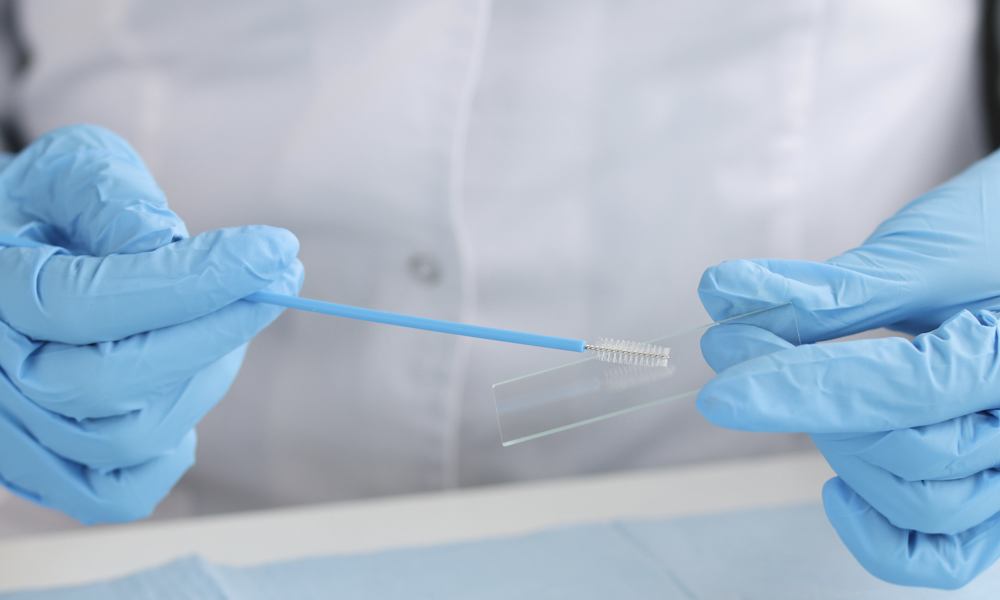
For the 15 per cent that are HPV positive, we check for abnormal cells by making a cervical cytology slide that is screened by a primary screener using a microscope. If an abnormality or suspected abnormality is seen this is then checked by a biomedical scientist and then by myself, a consultant biomedical scientist or one of my consultant colleagues.
What role does the lab play in screening for cervical cancer?
The lab really underpins the whole screening programme, which is designed to protect women from cervical cancer and empowers clinical decision making. Put simply, without the diagnostic capabilities of the lab, the cervical screening programme would not be possible.
Through the use of technology and employment of skilled technicians and scientists we process and report cervical screening samples, which is the crucial first step on the patient pathway after a person has attended for testing.
Even with innovations in technology and testing, such as self-sampling, we will always need staff to analyse results. Cytologists and laboratory staff are behind every result and every screening.
What are the challenges you face?
The biggest issue is staffing – both recruitment and retention. This is in part due to the consolidation of labs in England – down from 50 in 2018 to eight in 2019 – that came after the move to HPV primary screening.
The actual geography of the labs now means it can be difficult to recruit trained and experienced staff as not all labs are a commutable distance apart.
We are also facing a workforce gap at different levels and a potential staffing crisis, especially at consultant level, where we are facing a large number of staff at, or approaching, retirement age. We are unable to fill these gaps quickly as it can take up to ten years to obtain the right qualifications and experience required for such roles.
We are also anticipating that by the end of this year, we’ll be very busy as we hit the delayed three-year recall rate, caused by the COVID pandemic impacting access to screening appointments. I know some colleagues across the country are already facing backlogs as we speak.
What changes are you seeing in the lab to meet the demand of cervical cancer screening?
We’ve seen innovation in different areas – such as with automated data entry. For example, in my own lab we receive pre populated screening request forms, the information is downloadable, and allows us to easily see a woman’s screening history. It streamlines our admin processes as we minimise time spent manually inputting this vital information.
What we’re now needing is automated technology for screening. We still rely completely on using a microscope and reviewing a slide takes on average ten minutes, and looking for abnormal cells really is like looking for a needle in a haystack in some cases, it can be very time consuming.
However, we have seen very promising innovation in new technology that is bespoke to cervical screening. Technology advances for cytology screening uses AI and digital imaging to create images of the cervical cytology slides, which can then be analysed much quicker as it locates and provides us with images of the most diagnostically relevant cells.
I see huge potential in this innovation. Not only to help with efficiency in the programme but also to help tackle current staffing issues by allowing us to better share samples between the labs when required. We could also easily share samples for a second opinion and those at consultant level could do their reviews remotely.
This new technology is a brilliant way to support what we currently do – enhancing the screening process and allowing us to focus on the crucial interpretation element, while adding resilience and sustainability to the programme.
We are looking to the future and working together with the other labs to trial this technology for comparative studies to see how it compares to what we do now. I’m excited to see the results and the potential impact this could have on our national cervical cancer screening programme.
What does the future hold for cervical cancer screening?
We’ve had the screening test as we know it since the 1940s, and an organised cervical screening programme since the 1980s, but it’s not been until the introduction of HPV primary screening in recent years that we’ve really seen a technology revolution within the programme.
I see even more changes to come in the next five to ten years, from the introduction of new technology and the role of self-sampling, to the fact that we are now seeing women from the HPV vaccinated cohort starting routine screening, which could likely impact the results we see.
It’s an exciting time to be working in this field and I look forward to seeing what the future holds.


Newsletter
Sign up for free weekly updates
The latest femtech news, research and investment, straight to your inbox.




